









Intro
If you’ve come across the term tubefalire, you’re not alone. It’s one of those words that can look familiar at first glance, yet still leave you wondering what it actually means in practice. Some people use it when they’re talking about digital systems and performance behavior, while others bring it into conversations about failures, breakdowns, or troubleshooting in day-to-day workflows.
This guide is written to help you make sense of tubefalire without hype. You’ll get a clear definition, a practical “how it works” explanation, common causes, benefits, downsides, budgeting thinking, and a step-by-step start plan. You’ll also find a troubleshooting section and a set of FAQs that address the questions readers typically ask when they want real clarity.
| Label | Information |
|---|---|
| Term | Tubefalire |
| Type | Informal concept |
| Purpose | Describes breakdowns or underperformance patterns |
| Origin | Evolved from content and system reliability issues |
| Common Contexts | Content delivery, system performance, user experience |
| Focus | Mismatch between inputs, system response, and outcome |
| Core Areas | Inputs, system response, outcome pattern |
| Key Causes | Algorithm misalignment, engagement decay, metadata inefficiency |
| Common Types | Underperformance, system failure, user friction |
| Prevention | Structured approach, clear inputs, routine checks |
| Benefits | Improved diagnosis, better prevention, stable outcomes |
| Risks | Vague labeling, over-focusing, ignoring technical issues |
| Maintenance | Regular checks, preventive care, observation routines |
Quick Summary You Can Trust
- Tubefalire is used as an informal umbrella term for breakdowns or underperformance patterns especially where “video/tube-style” ecosystems, content delivery, and system behavior intersect.
- In some write-ups, it’s framed as a blend of content performance strategy and technical/system reliability thinking, rather than a single branded product.
- People often run into tubefalire when content (or a system outcome) doesn’t match expectations due to a mismatch between inputs (metadata, intent, configuration) and the way platforms or systems respond.
- The most useful approach is structured: define the goal, observe the pattern, identify likely causes, then apply prevention steps and maintenance habits.
What Tubefalire Means (In Plain Language)
At its simplest, tubefalire refers to a situation where something you expect to work “smoothly” ends up behaving in a less reliable way where performance drops, delivery fails, or outcomes don’t match effort. Depending on the context, the term is used either:
- As a content-and-platform concept (how “tube-style” video ecosystems can reduce reach or engagement despite decent effort), or
- As a systems and failure concept (how technical inefficiencies, errors, or instability show up during operation).
Some explanations describe tubefalire as a hybrid idea: tube implies video-sharing or recommendation ecosystems, and failure implies breakdowns in performance, engagement, or delivery.
Importantly, many sources also emphasize that it is not tied to a single official product or platform. Instead, it’s an evolving label people use to describe recurring patterns they notice.
The Core Idea Behind Tubefalire
To understand tubefalire, think in three layers that influence each other.
1) Inputs
These are the things you control or configure. In a content context, inputs can include titles, descriptions, thumbnails, topic selection, and posting timing. In a technical context, inputs can include configuration settings, integration behavior, and workflow steps.
2) The system response
This is how a platform or system interprets the inputs. Even strong inputs can underperform if the system interprets signals differently than expected.
3) The outcome pattern
That’s what you observe: lower-than-expected distribution, inconsistent performance, early drop-off, delivery delays, or unstable behavior. When people see these recurring patterns, they often call it tubefalire.
How Tubefalire Can Show Up (Mechanism Explained)
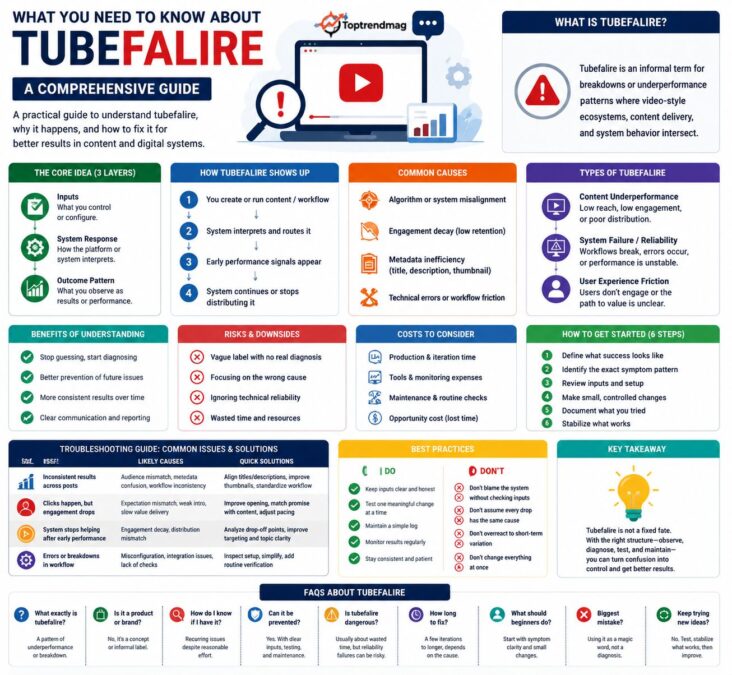
Even though tubefalire is often described informally, the underlying reasoning pattern is consistent. It typically follows this chain:
First, you create or run something (content or a workflow).
Next, the system attempts to interpret and route it.
Then, you see early performance signals (whether it gains traction or stalls).
Finally, the system either continues distributing it or it stops short due to mismatch in signals, decay in engagement, or inefficiency in how signals are processed.
Let’s break that down into a practical, “you can diagnose it” model.
Step 1: Algorithmic or system misalignment
Some discussions connect tubefalire to algorithmic misalignment when recommended distribution doesn’t reach the audience it should, even if the content or solution is relevant.
Step 2: Engagement decay (in a content setting)
A common pattern is that the first audience interaction happens quickly, but then retention or deeper engagement drops. When watch time or sustained interaction falls, systems may treat the content as less valuable and reduce future distribution.
Step 3: Metadata inefficiency
In content contexts, metadata matters: titles, descriptions, and thumbnails help systems infer what the piece is about and who should see it. If metadata under-explains, over-promises, or confuses intent, outcomes can fail to match the creator’s goal.
Step 4: Technical or workflow friction
Some sources expand the term into technical explanations: inefficiencies, errors, unexpected failures, or instability in digital infrastructure can lead to inconsistent outcomes.
You don’t need to treat tubefalire as a mystery. You can observe it like a performance diagnosis problem.
Types of Tubefalire You’ll Likely Encounter
Because tubefalire is an informal label, “types” usually mean “different ways the problem appears.” These are the most common buckets described in guides:
Tubefalire as underperformance in content delivery
This includes situations where a post or video doesn’t reach the audience you intended, or reach drops unexpectedly.
Tubefalire as a system failure or reliability issue
This includes situations where a digital workflow stops working correctly, behaves inconsistently, or fails in a way that breaks the expected experience.
Tubefalire as user experience friction
This includes situations where the experience isn’t smooth: users click but don’t engage, or the pathway to value is unclear leading to reduced performance signals.
The real advantage of grouping problems this way is that your response becomes clearer: you’ll use different fixes for “distribution mismatch” versus “workflow reliability.”
Benefits of Understanding Tubefalire (Yes, There Are Benefits)
It can feel uncomfortable to label a problem. But learning tubefalire as a structured concept helps you act instead of guessing.
Benefit 1: You stop relying on gut feeling
When you understand the likely failure points inputs, system response, outcome you reduce random trial-and-error.
Benefit 2: You get better at prevention
Instead of fixing after the damage, you build habits that make breakdowns less likely.
Benefit 3: You improve long-term consistency
People usually notice tubefalire when results become inconsistent. A structured approach helps stabilize outcomes over time by addressing root causes rather than only symptoms.
Benefit 4: You speak a clearer “diagnosis language”
Even if the term is informal, the thinking style is practical. You can explain what happened, what you tested, and what you changed.
Risks, Downsides, and Misuse of the Term
Let’s be honest: tubefalire can be misused.
Risk 1: Turning it into a vague label
If someone uses tubefalire but can’t explain what actually went wrong, it becomes a convenient excuse rather than a diagnostic tool. That leads to wasted effort.
Risk 2: Over-focusing on one cause
For example, improving metadata alone might not fix a deeper mismatch between audience intent and distribution behavior.
Risk 3: Ignoring technical reliability
If your context is digital systems, not only content, you can’t assume the issue is “just marketing” or “just creativity.” Some explanations treat tubefalire as bridging content strategy and system reliability.
A strong approach is to treat tubefalire as “a pattern worth diagnosing,” not a fixed fate.
Costs and Budgeting Thinking Around Tubefalire
Even when tubefalire isn’t tied to a specific product, there are real cost categories attached to solving it:
1) Production and iteration costs
You may spend time rewriting titles, refining thumbnails, improving scripts, or adjusting workflows. That time has cost, even if it isn’t billed hourly.
2) Tools and monitoring costs
Fixing performance patterns often requires measurement and observation. That can mean analytics tools, monitoring, or workflow tracking.
3) Maintenance costs
If the issue is partly technical, you’ll likely need routine maintenance habits. In general maintenance guidance across industries emphasizes inspection, calibration, and preventive care to reduce unexpected downtime and safety issues.
4) Opportunity costs
Every day spent chasing the wrong assumption delays the solution.
A practical budgeting method is to separate spending into “observe,” “test,” and “stabilize.”
- Observe costs: gather enough signals to understand the pattern.
- Test costs: do small changes with measurable outcomes.
- Stabilize costs: keep what works and reduce repeated breakdown triggers.
Step-by-Step: How to Get Started with Tubefalire Diagnosis
You can begin without being technical, but the steps are easier if you follow a calm structure.
Step 1: Define what “success” means
Write one sentence: what outcome do you want?
Examples: “I want consistent reach,” “I want improved retention,” or “I want fewer workflow errors.”
Step 2: Identify the exact symptom pattern
Choose what matches what you’re seeing:
- Lower initial engagement than expected
- Short time-on-task or early drop-off
- Inconsistent delivery or reliability
- Confusing mismatch between intent and audience response
Step 3: Look at inputs first
In content contexts, review titles, descriptions, and thumbnails for clarity and honest intent. In technical contexts, review configuration and workflow steps for inefficiency or errors.
Step 4: Run small controlled changes
Don’t replace everything at once. Make one change, then observe whether the pattern improves.
Step 5: Document what you tried
If you don’t write it down, you’ll forget what worked. A simple log helps you build a consistent improvement loop.
Step 6: Stabilize what works
Once you find something that reduces tubefalire outcomes, keep it. Repeat success patterns rather than reinventing from scratch.
Maintenance and Longevity: Keep Breakdowns From Returning
Maintenance is where many people succeed or quietly fail.
Routine checks (simple and effective)
- Review performance signals regularly (weekly is often enough for most projects).
- Confirm your inputs still match your intended audience or system goal.
- Keep your workflow clean and consistent so you reduce avoidable friction.
“Maintenance mindset” for technical or reliability contexts
Preventive maintenance guidance from occupational safety and industrial contexts often highlights inspection, testing, calibration, and proactive checks to reduce unexpected failures.
Even if you’re not running industrial equipment, the mindset transfers well: preventive care is usually cheaper than emergency repair.
Signs you need to upgrade or rethink
- The same issue repeats after every “quick fix.”
- Improvements slow down even after changes.
- Your results become unpredictable without a clear reason.
At that point, you don’t just patch. You revise the system of decisions.
Troubleshooting Guide: Common Issues and Solutions
Below is a practical guide for diagnosing tubefalire patterns. Use it like a checklist.
Issue: Results are inconsistent across posts or weeks
Likely causes
- Audience mismatch due to unclear intent signals
- Metadata confusion
- Workflow friction or inconsistency
Quick fixes
- Make sure titles and descriptions match what viewers actually get
- Improve clarity in thumbnails
- Standardize your creation and posting process so the “inputs” are consistent
This aligns with common discussions about metadata inefficiency and misalignment contributing to tubefalire outcomes.
Issue: Clicks happen, but engagement drops fast
Likely causes
- Expectation mismatch (promise vs. content delivery)
- Intro section doesn’t retain attention
- Users don’t find value fast enough
Quick fixes
- Tighten opening segments to deliver the value earlier
- Re-check whether the thumbnail/title accurately represents the content
- Adjust pacing so the first few minutes are more compelling
Issue: The system seems to “stop helping” after early performance
Likely causes
- Engagement decay: early interaction exists, but sustained signals don’t follow
- Distribution mismatch: the system didn’t route your content to the right audience
Quick fixes
- Analyze where viewers drop off and revise that segment
- Improve audience targeting (topic specificity and clarity)
This reflects common explanations that engagement decay and system alignment affect distribution behavior.
Issue: Errors or breakdowns appear in a workflow
Likely causes
- Misconfiguration
- Integration issues
- Lack of preventive checks
Quick fixes
- Inspect setup and configuration steps
- Reduce complexity temporarily to isolate the failure point
- Add routine verification so the same error doesn’t return
Reliability thinking often borrows from preventive maintenance principles: inspect, test, calibrate, and eliminate hazards before they escalate.
FAQs About Tubefalire
1) What exactly is tubefalire?
Tubefalire is an informal concept describing patterns where performance, delivery, or outcomes break down often framed as a mix between content strategy and system reliability.
If you’ve seen inconsistent results that don’t match your effort, you may have been experiencing what people describe as tubefalire.
2) Is tubefalire a product or a brand?
Most descriptions treat tubefalire as a concept or label, not a single official tool with one universal definition.
That’s why context matters.
3) How do I know if I’m dealing with tubefalire?
You’re likely dealing with tubefalire when you notice recurring underperformance or breakdown patterns that keep repeating despite reasonable effort.
The key is to identify a consistent symptom, not a one-time glitch.
4) What are the most common causes?
Commonly discussed causes include algorithmic or system misalignment, engagement decay patterns, and metadata inefficiency in content contexts.
In technical contexts, causes can include inefficiencies, errors, or system instability.
5) Can tubefalire be prevented?
Yes often. A structured approach helps: clarify intent, improve inputs, test changes, and maintain routines so failures don’t return automatically.
6) Is tubefalire dangerous?
It depends on context. If you’re referring to general digital performance issues, “danger” is usually about wasted time or poor outcomes, not physical harm.
If you’re using the term in an industrial or technical reliability context, you should treat reliability failures seriously and follow appropriate safety and maintenance practices. Preventive safety guidance emphasizes inspection and proactive checks to reduce unsafe conditions.
7) How long does it take to fix?
If the issue is mainly content clarity or metadata mismatch, you may see improvement after a couple of iterations.
If it’s deeper system reliability or workflow failure, it can take longer because you’ll need verification, stability changes, and maintenance routines.
8) What should beginners do first?
Start with symptom clarity. Define success, identify what’s wrong, then make small controlled changes to inputs.
Avoid “big rewrites” before you understand the pattern.
9) What’s the biggest mistake people make with tubefalire?
The biggest mistake is treating it like a magic word instead of a diagnosis. If you can’t point to the symptom pattern and the likely cause, you can’t fix it reliably.
10) Should I keep trying new ideas endlessly?
No. Once you test a change and it helps, stabilize the approach. If nothing changes, stop guessing and revisit your assumptions about inputs, system response, and the outcome pattern.
Best Practices: Practical Rules That Work
Do
- Keep your inputs clear and honest.
- Test one meaningful change at a time.
- Maintain a basic log of what you changed and what happened.
These practices reduce confusion and help you avoid repeated tubefalire cycles.
Don’t
- Don’t blame the system without checking your inputs.
- Don’t assume every drop is the same root cause.
- Don’t overreact to short-term variation.
Tubefalire is a pattern label, not a single event.
Alternatives to Consider (When Tubefalire Isn’t the Right Framing)
Sometimes people want to treat tubefalire as the answer to everything. If your problem is narrower, other frameworks may fit better:
- Performance debugging: treat the system like a troubleshootable pipeline.
- Content optimization: treat outcomes as a result of clarity, retention, and expectation matching.
- Reliability and maintenance planning: treat failures as preventable through routine checks.
Even though tubefalire can be useful, you should choose the framework that matches your reality.
Conclusion: Turn Confusion Into Control
If you’ve been searching for what you need to know about tubefalire, the takeaway is simple: it’s a label people use to describe recurring underperformance or breakdown patterns where content strategy and system response intersect.
When you approach it with calm structure define success, observe the symptom pattern, check your inputs, run controlled tests, and maintain routines you stop getting stuck in loops. You also gain confidence because you can explain what changed and why it worked.
If you want, tell me what context you’re writing for (content creator, marketer, developer, or general reader). I can tailor the troubleshooting examples and the “types” section to fit your audience more precisely