








Intro
If you’ve spent any time around a Cadillac Lyriq owner, you’ve probably heard it: “Try Sport once, then go back to Tour and watch how your efficiency changes.” But what’s actually happening when you switch modes? Are you really getting different ranges, or is it just your driving style? And does any mode meaningfully change how the battery is used?
So let’s answer the question you searched for do the driving modes in cadillac lyriq offer different ranges or battery usages? in a way that’s practical, clear, and grounded in how EV systems work.
A key thing up front: the Lyriq’s driving modes do not change the battery’s total capacity. Instead, they change how the car uses the battery through throttle mapping, power delivery behavior, and how the vehicle handles traction and acceleration response. Cadillac describes the intent of these modes as tailoring performance to road conditions and driver preferences, including changes to pedal mapping and torque response for slippery conditions, and a sportier calibration for Sport mode.
What that means in real life is this: you should expect differences in consumption especially in stop-and-go traffic, hilly routes, and any drive where you accelerate often. The estimated range can shift because energy use changes, not because the battery got bigger.
| Label | Information |
|---|---|
| Car Model | Cadillac Lyriq |
| Type | Electric SUV |
| Driving Modes | Tour, Sport, Snow, and One-Pedal Driving |
| Battery Capacity | 100 kWh |
| Range | Up to 312 miles (on a full charge) |
| Performance Mode Impact | Increases power and acceleration, reduces range |
| Efficiency Mode Impact | Enhances range, reduces power usage |
| Optimal Mode for Range | Tour mode |
| Charging Time | Around 19 hours (120V), 10.5 hours (240V) |
| Top Speed | 118 mph |
| 0-60 mph | 4.6 seconds |
| Origin | Designed in the USA |
| Key Selling Point | All-electric, luxury SUV with customizable driving modes |
Range isn’t a single number it’s a result
When people say “range,” they usually mean the number shown on the dashboard that estimates how far you can go on a full charge. In reality, that number is an estimate built from current conditions and driving history.
EV range is driven by energy demand, which changes with:
- Speed and how steadily you drive
- How often you accelerate hard
- Weather and temperature
- Road grade (hills)
- Tire type and tire pressure
- HVAC use
- How much braking you do and how effectively energy can be recovered
Driving modes fit into this picture because they influence how quickly the vehicle delivers torque and how it responds when you press the accelerator. Cadillac’s own description of mode behavior highlights that modes tailor acceleration and torque response and that some modes (like Snow/Ice) adjust the pedal map to slow acceleration and reduce wheel slip risk.
What driving modes can change on an EV
Think of an EV as balancing energy in a few major areas: pulling power from the battery to move the car, and sometimes pushing energy back during deceleration. Driving modes don’t rewrite physics, but they do alter system control strategies.
1) Throttle response changes how you use power
Sport-style calibrations typically make the car feel more responsive. In software terms, that usually means the mapping between pedal position and torque is less gradual. Even if you tell yourself you’re “not driving aggressively,” a more sensitive pedal makes it easier to command higher torque sooner.
Higher torque demand generally increases average energy consumption because the battery is asked to deliver more power over more moments in the drive.
Cadillac’s mode descriptions make the “calibration” idea explicit: Tour emphasizes normal acceleration and comfort for everyday driving, while Sport tightens steering response and includes a more responsive engine calibration for a sporty feel.
2) Modes for slippery roads change torque and wheel behavior
Modes like Snow/Ice are designed to adjust how the vehicle delivers torque when traction is limited. Cadillac notes Snow/Ice adjusts the pedal map by slowing acceleration and torque response to help prevent wheel slip and improve performance on slippery surfaces.
That doesn’t automatically mean “better range.” In low-traction conditions, you may have less efficient motion (and sometimes more power losses), but the primary goal is control and safety. Still, because energy demand can change, consumption can change too.
3) My Mode can change feel without changing the battery size
Cadillac describes My Mode as configurable and lets you personalize steering, braking, acceleration feel and responsiveness, and motor sound through the display.
Because My Mode is user-configurable, it’s where the biggest “range differences” can come from not because it changes the battery, but because it can change how much power you tend to request.
4) Some modes are about drivetrain behavior, not efficiency
Depending on configuration, Cadillac also lists additional driving-mode types such as Off-Road, Terrain, Tow/Haul, Weather, and Track.
These are primarily about traction management, gear/drive behavior, or control feel. Efficiency is usually a secondary concern.
If a mode is designed to keep torque available longer, or prioritize control during maneuvers, it can lead to higher energy use when compared to a relaxed, everyday calibration especially if you’re not actively driving in the conditions those modes were meant for.
Do modes impact battery usage? Yes but mostly in how energy is drawn
“Battery usage” can mean several things:
- Total energy used (kWh consumed per mile)
- Power peaks (how hard you ask the battery to work)
- Thermal load (how much heat is generated and managed)
Driving modes strongly influence the first one (energy used per trip) because torque delivery and acceleration response change how quickly you can demand power.
The second and third are also affected indirectly:
- Sportier responses can lead to higher peak power requests.
- More aggressive driving increases heat generation in the drivetrain.
- Extra heat management can consume additional energy (so the battery is “used” differently even if the pack is the same).
Cadillac’s published specs for the 2024 Lyriq show a battery rated energy value (102 kWh) and note that actual range varies with factors like temperature, terrain, battery age, and loading.
The important takeaway is that range variation is expected even without changing modes so modes add another lever that can move the result.
So which Lyriq modes usually help range?
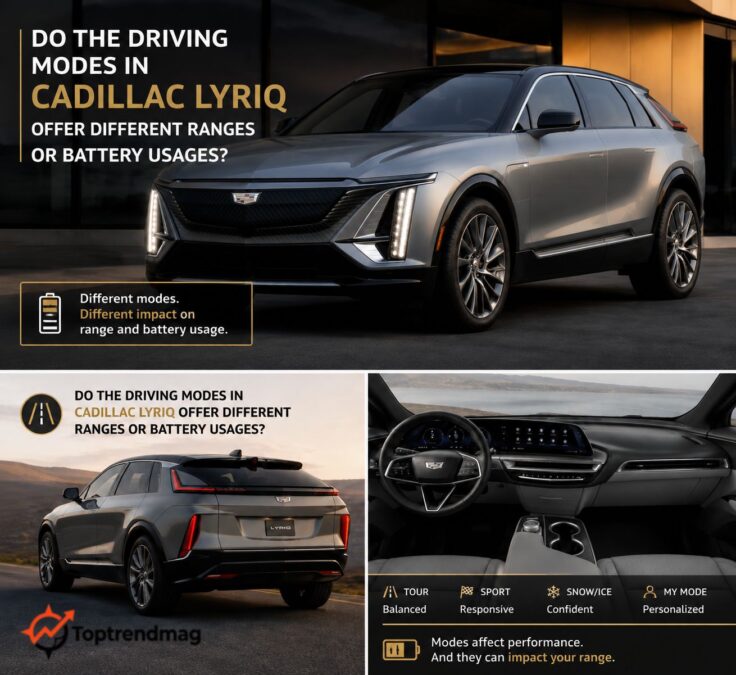
Here’s the practical answer you can use while deciding what to select on your drive.
Tour
Tour is described by Cadillac as providing normal acceleration and comfortable ride tuning for everyday driving.
In general, this kind of calibration tends to encourage smoother power use. Smoother power requests usually mean steadier, lower average consumption especially in mixed city driving.
Sport
Cadillac describes Sport as tightening steering response and using more responsive suspension and engine calibration for a sporty feel.
In real-world terms, Sport often correlates with:
- More rapid torque response
- Faster acceleration events
- More frequent high-power moments
Even if you’re not flooring it constantly, Sport’s responsiveness can make it easier to accelerate more than you intended. That usually reduces range compared with Tour on the same route particularly in stop-and-go driving.
Snow/Ice
Cadillac states Snow/Ice adjusts pedal mapping to slow acceleration and torque response to help prevent wheel slip on slippery surfaces.
This mode’s efficiency impact depends heavily on conditions:
- If you’re driving carefully and traction is limited, the mode may help you avoid inefficient wheel spin (which can otherwise waste energy).
- If conditions force you to crawl or brake often, total consumption can rise simply due to the environment.
My Mode
Because My Mode is configurable, it can produce a wide range of outcomes.
If you set My Mode closer to Sport-like acceleration response, you can expect higher consumption. If you set it closer to Tour-like calm behavior, you can often recover much of the efficiency benefit.
The biggest “range differences” show up in specific driving
To make this feel real, let’s talk about situations where switching modes is most likely to change your energy use.
City driving and traffic
In traffic, you’re constantly accelerating and slowing down. That’s where throttle response becomes a major factor.
Sport can change:
- How quickly you begin acceleration after each slowdown
- How much torque you request during merges
- How “responsive” the car feels during small pedal inputs
Tour tends to encourage more gradual requests, so consumption often stays lower assuming you maintain a similar driving style.
Hills and grades
On climbs, you’re asking the motor for consistent traction power. If you drive in Sport and find yourself requesting more torque sooner, average consumption climbs.
On descents, regenerative energy recovery depends on deceleration behavior and traction conditions. Even without obsessing over regen, a mode that makes you accelerate more aggressively on the next climb can net out to lower efficiency across the full loop.
Steady highway cruising
This is the opposite case: on steady highway cruising, range differences between modes often shrink.
Why? Because highway efficiency is dominated by:
- Aerodynamic drag (strongly tied to speed)
- Rolling resistance
- HVAC energy use
- Grade and wind
Modes still influence torque delivery, but if your speed is constant and your throttle inputs are minimal, you may see smaller changes in consumption between Tour and Sport.
A simple test you can do without special tools
If you want confidence instead of guessing, do this:
Step 1: Choose a route
Pick a route with similar:
- Distance
- Terrain (mostly flat vs hilly)
- Typical traffic conditions
Try to avoid mixed days that include wildly different weather or a different tire pressure scenario.
Step 2: Pick one mode per run
Example: Tour for one drive, Sport for another.
Step 3: Drive similarly
This is where people accidentally bias results. To keep it fair, try to:
- Match average speed
- Avoid “I’ll just try Sport harder this time”
- Keep acceleration patterns as consistent as you can
Step 4: Record consumption
Use the vehicle’s energy/consumption display. Track:
- How many kWh were used for the trip (or the consumption figure the car provides)
- The average efficiency result
Step 5: Repeat
Run it at least 3 times if possible. One “lucky” drive can trick you.
This matters because the Lyriq’s published guidance emphasizes that range and actual performance vary with temperature, terrain, battery age, loading, and maintenance.
Modes are part of the equation, but variability is real so repetition is how you tell signal from noise.
Myth check: “Sport always destroys range”
It’s tempting to treat Sport as automatically bad for efficiency. But the story is more nuanced.
Sport can lower range when it leads you to drive with higher torque peaks and more aggressive acceleration. Cadillac’s Sport description signals that it’s designed to feel more responsive and sporty.
But if you drive Sport smoothly and keep your speed steady, the difference can be smaller. In other words:
- Sport can change how easy it is to be aggressive.
- It doesn’t force aggression.
The most consistent efficiency wins usually come from driving style plus mode choice together.
What about battery health?
You didn’t ask directly about longevity, but it’s a common concern. The key idea is: using the battery differently (higher power peaks, more thermal load) can change stress patterns, even if capacity doesn’t instantly change.
However, “battery health” depends on multiple long-term factors, including charging habits and temperature exposure. The most reliable guidance is always to follow manufacturer recommendations in the owner’s manual for charging and temperature precautions.
For the purpose of this article’s question range and battery usage during driving the important point remains:
- Driving modes influence how much energy you use and how power is requested.
- They do not suddenly “unlock” extra battery capacity.
Cadillac’s own spec documentation also frames actual range as variable based on conditions and usage factors.
Choosing the right mode: clear recommendations
Here’s a quick, human-friendly decision guide.
If you need maximum range
- Use Tour
- Keep throttle inputs smooth
- Plan for steady speeds where possible
- In traffic, anticipate stops so you’re not repeatedly “pushing through” accelerations
If you want daily comfort without overthinking it
- Tour is usually the simplest default
- My Mode can be a great option if you personalize but still keep acceleration feel measured
If you’re driving in slippery weather
- Use Snow/Ice when appropriate
- The design intent is to adjust pedal map and torque response to help reduce wheel slip
If you’re heading out for spirited driving
- Sport can make the car feel more engaging
- Just accept that it often changes your energy consumption pattern compared to Tour, especially in stop-and-go and when acceleration is frequent
FAQs
- Do the driving modes in the Cadillac Lyriq change the car’s range?
Yes, the Cadillac Lyriq offers different driving modes that impact its range. The modes adjust power usage, with more efficient settings extending the driving range, while performance modes may reduce range for enhanced power and acceleration. - How does the Cadillac Lyriq’s battery usage vary between driving modes?
In more economical modes, the Lyriq optimizes battery usage to conserve energy, while performance modes draw more power from the battery to support faster acceleration and higher speeds. - Which driving mode in the Lyriq offers the best range?
The Lyriq’s “Tour” mode typically offers the best range, as it prioritizes energy efficiency and smooth driving for long-distance journeys. - Can I switch between driving modes in the Cadillac Lyriq while driving?
Yes, you can switch between modes while driving, but it’s advisable to do so safely and when conditions allow to optimize performance or efficiency based on your needs. - Does using sport mode in the Cadillac Lyriq reduce battery life?
Yes, using sport mode can reduce battery life as it draws more power for enhanced performance. It’s ideal for short trips or when performance is a priority over range.
Conclusion: Do Lyriq driving modes change range or battery usage?
Yes driving modes in the Cadillac Lyriq can lead to different ranges and different battery usage patterns. Not because the battery becomes bigger, but because the vehicle changes how it responds to your inputs and how it manages torque and traction behavior.
Tour is designed for normal, everyday acceleration feel, while Sport is calibrated to provide a more responsive, sporty experience.
And modes like Snow/Ice can adjust pedal mapping to slow acceleration and torque response for better control on slippery roads.
So when you switch modes, you’re mostly changing:
- how easily you request power,
- how the car delivers torque,
- and how conditions are managed
which then changes how much energy you burn on your specific route.
If you want the best real-world results, test one route, repeat it, and choose the mode that matches your goal range, comfort, or control rather than chasing a single “best mode” for every situation.