








Intro
Online safety has changed in small but important ways. Attackers don’t just “break in” anymore they try to convince you to open the door. That’s why reading about security matters, but also why security advice only helps when it turns into daily habits you can actually follow.
In this post, we’ll walk through the droven io cybersecurity updates theme the right way: not as vague warnings, but as practical improvements you can apply to your accounts, devices, and routines. We’ll also anchor the guidance in credible security and identity standards from organizations like CISA and NIST, which focus on what reduces real-world risk.
Bio
| Label | Information |
|---|---|
| Name | Droven IO Cybersecurity Updates |
| Type | Online security update program |
| Purpose | Protect users from cyber threats |
| Key Focus | Phishing prevention, MFA, session security |
| Origin | Droven IO platform |
| Target Users | Individuals and businesses online |
| Main Feature | Actionable security improvements |
| MFA Guidance | Check settings, backup codes, trusted methods |
| Recovery Focus | Secure email and phone recovery |
| Session Safety | Revoke unknown sessions, sign out devices |
| Device Updates | OS, browser, and app patching |
| Backup Advice | Separate, testable backups |
| Recommended Action | Review MFA, verify urgent messages |
Why “latest updates” matter for everyday people
A lot of security advice stays the same use strong passwords, don’t click suspicious links. The difference now is that attackers are adapting faster than many people are. Phishing attempts can look sharper, messages can feel more personalized, and “verification” requests can be timed to coincide with moments when you’re distracted.
CISA emphasizes that phishing messages can appear in many forms email, text, direct messages, and phone calls and that you shouldn’t rely on superficial cues like how legitimate something looks.
So when you hear about the latest updates, the real question becomes: What should I do differently today because threats evolve?
What attackers are focusing on right now
Before we get into protection steps, it helps to understand the attack goals. Most modern campaigns aim at one of these outcomes:
- Account takeover (especially email, because it controls password resets)
- Credential theft (via phishing, fake pages, or malware)
- Session persistence (stolen “in-between” access that remains useful even after a password change)
- Ransom pressure (or extortion) after sensitive data is obtained
- Fraud and financial redirection using compromised identities
Even when you use MFA, attackers can still succeed if they trick you into approving the wrong action or if the method of MFA isn’t resistant to the specific phishing pattern. That’s not an argument against MFA it’s a reason to configure it thoughtfully. Identity guidance from NIST covers authentication and lifecycle management in detail, including requirements and risk-based considerations.
The core idea behind the droven io cybersecurity updates approach
A good cybersecurity update should do three things:
- Translate threat changes into behavior changes
- Reduce confusion so people know what to check first
- Make prevention repeatable rather than a one-time “fix”
A theme you’ll see across many credible security programs whether government or standards bodies is that humans and process matter. CISA’s guidance on avoiding phishing stresses education and behavioral checks because attackers increasingly tailor messages to look plausible.
So below, we’ll treat the droven io cybersecurity updates concept like a checklist-driven upgrade to your online safety.
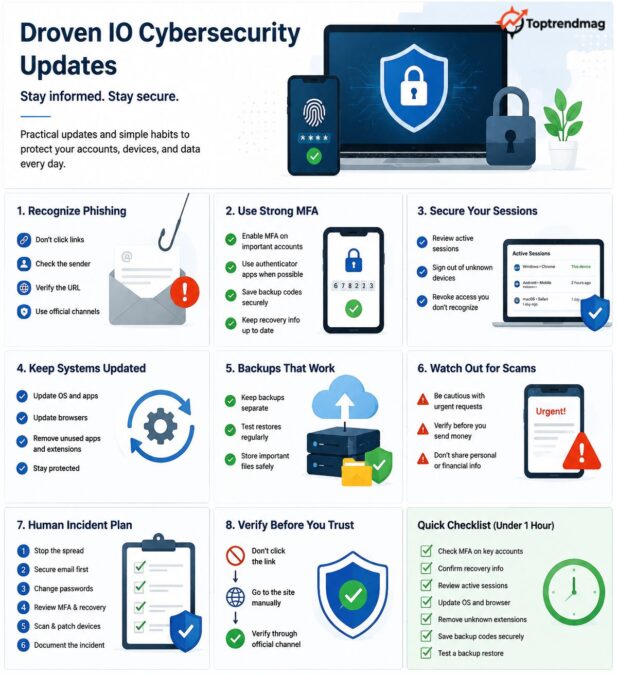
Recognize and stop phishing before it becomes a breach
Phishing is still the most common first step in many incidents. CISA’s phishing recognition guidance is blunt: suspicious messages often follow familiar patterns, and when something looks suspicious, it often is.
What “latest” phishing behavior looks like
Phishing is moving beyond obvious mistakes. Security coverage in 2025–2026 continues to highlight that AI and automation can improve formatting and reduce spelling errors, which means you can’t rely on grammar as your primary filter.
That’s why the better approach is to focus on verification behavior:
What you should do instead of relying on appearance
If a message asks you to act fast, treat it as untrusted until verified. CISA’s phishing tip sheets and guidance reinforce that you should not click or take action based solely on “this looks like it came from the right place.”
Here’s a simple routine you can use:
- Do not click the link in the message.
- Open a new browser tab.
- Go to the service by typing the site manually or using a bookmark you control.
- Check whether the account issue is real.
- If the message claims to be urgent, verify through a different channel (for example, calling a known number or using the official app).
This routine is small, but it breaks the attacker’s workflow.
Strengthen accounts with MFA that’s configured for reality
Multi-factor authentication (MFA) is one of the best upgrades you can make, but it isn’t one-size-fits-all. NIST explains MFA and authentication lifecycles through SP 800-63B, including requirements for authentication processes.
What to check now
Bold recommendation: review MFA settings for your most powerful accounts.
Start with:
- your email account
- your password manager (if separate)
- banking and payment services
- cloud storage where documents sync
- work accounts (if applicable)
Then check these details:
- Are you using MFA methods that you actually trust?
- Do you have backup codes stored securely?
- Is your recovery email/phone still controlled by you?
- Do you have any suspicious “remembered devices” or active sessions?
Why the “recovery” part matters
Many breaches don’t begin with login they begin with recovery manipulation. Attackers who control your recovery options can reset passwords even if you notice a problem later. NIST guidance includes lifecycle management considerations that cover how authenticators and related processes should be handled over time.
Harden session security and protect against token misuse
A growing security lesson is that passwords are not the only target. Attackers may try to capture session access while you’re authenticated so simply changing a password isn’t always enough to remove the threat.
While specific mechanics vary by service, the protective habits are consistent:
- Revoke active sessions when you suspect compromise
- Sign out of devices you don’t recognize
- Avoid “random convenience” logins on shared or untrusted devices
- Keep your browser and OS patched
In practical terms, the safety step is: treat session review as part of incident response, not as a thing you only do after a dramatic hack.
Patch devices and browsers like your privacy depends on it
Many successful attacks depend on the victim using software that’s out of date. Updates reduce the window for known vulnerabilities and improve protection layers that attackers target.
Security reporting and guidance commonly pair phishing risk with endpoint risk: even if you don’t download malware intentionally, an out-of-date system or browser can increase exposure.
Bold habit to adopt: make updates routine, not occasional.
- Update the operating system when prompted
- Update browsers promptly
- Remove unused extensions
- Audit installed apps you didn’t intentionally add
This isn’t exciting work, but it’s reliable risk reduction.
Backups: the part people skip until it hurts
Backups are one of the most important defenses against ransomware but with a twist. Backups must be more than “something that exists.” CISA’s ransomware response checklist emphasizes structured steps during incidents, including recovery and restoration triage.
A better backup mindset
If you rely on automated cloud syncing, consider whether your backups could be affected by the same compromise that encrypts or corrupts files. Even without going deep into technical details, the safer approach is to ensure backups:
- are separated from daily editing systems
- can be restored and tested
- include recovery steps you understand before an emergency
Bold principle: backups should be testable. “We have backups” isn’t the same as “we can restore quickly.”
Spot scams that target money, not just data
Phishing often aims at identity theft, but many scams aim at money movement and fraud. That includes:
- invoice fraud
- gift card requests
- account “verification” scams
- impersonation in DMs and email
CISA’s phishing guidance materials explain how messages can impersonate trusted entities and request actions that expose personal or financial information.
A verification rule you can remember
If someone pressures you with urgency and asks you to act through a link, pause and verify via an independent channel.
Even if you feel silly doing it, your future self will appreciate the extra minute.
A human incident plan: what to do if you suspect compromise
The moment you suspect you’ve been targeted, you should switch from “internet browsing mode” to “containment mode.”
Here’s a calm, effective sequence:
Step 1: Stop the spread
- Don’t keep entering credentials on suspicious pages
- Don’t keep clicking “follow-up” messages
Step 2: Secure email first
Email is usually the key for password resets. If email is compromised, other accounts often fall quickly.
Step 3: Change credentials after securing the root cause
Change passwords only after you’ve secured the primary access point (commonly email). Then revoke sessions and devices you don’t recognize.
Step 4: Review MFA and recovery settings
Make sure your recovery phone/email matches your control, and confirm backup codes are secure. NIST’s authentication lifecycle management guidance supports the idea that authenticators and their management matter over time.
Step 5: Scan devices and patch
Update OS/browser, then run trusted security scans.
Step 6: Document what happened
Write down:
- dates and times
- message subjects and sender details
- screenshots of the suspicious content
- any URLs involved
CISA’s approach to phishing recognition and reporting emphasizes taking suspicious events seriously rather than brushing them aside.
A practical checklist you can do in under an hour
If you want a quick “droven io cybersecurity updates” action step, use this:
- Check MFA on your email and payment accounts
- Confirm recovery details (email/phone) are yours
- Review active sessions/devices
- Update your OS and browser
- Remove unknown browser extensions
- Save backup codes in a secure place
- Test a backup restore plan (even a small test folder)
This list is straightforward, and it’s designed to reduce the most common real-world failure points: weak recovery control, missing MFA readiness, and outdated systems.
Frequently asked questions
Is MFA enough?
MFA is a strong step, but security is layered. NIST’s digital identity guidelines cover authentication lifecycle management and risk considerations, and CISA stresses recognizing and responding to phishing behaviors that can still lead to compromise if you approve or follow malicious instructions.
Should I change passwords if I wasn’t hacked?
If your passwords are old or reused across services, the risk is higher. Consider changing passwords for your most critical accounts, especially email. Then review session activity and recovery settings.
What if I clicked a phishing link?
Stop entering credentials. If you entered your password, assume compromise and secure your email account first. Review sessions, rotate passwords, and scan devices.
How do I verify messages safely?
Use an independent verification method: don’t click the link, navigate manually, and confirm via official app or a known contact method. CISA’s phishing guidance supports this behavior-based approach.
Conclusion: turn updates into habits that protect you
The best way to use droven io cybersecurity updates is not to treat them like news you forget after reading. Instead, treat them as signals for behavior you repeat: verify before you trust, secure recovery before you need it, review sessions, keep systems updated, and ensure backups are restorable.
If you do just one thing today, make it this:
Review MFA and recovery settings on your email account, then verify any “urgent” messages before clicking.
That combination alone blocks a large portion of real-world account takeover attempts.