






Intro
If you’ve been around online games long enough, you already know that “cool gameplay” isn’t the whole story. Players stick around for the moments that feel rewarding, the systems that keep improving over time, and the people who make the experience warmer than it would be on your own. That’s the idea behind harmonicode gaming a way of thinking about games that blend responsive mechanics with shared energy and community momentum.
In this article, you’ll learn what harmonicode gaming tends to emphasize, how the best versions of this concept deliver fun without feeling gimmicky, and what community practices actually keep players coming back. I’ll also share practical guidance you can use whether you’re trying the platform or building a community culture around it.
Before we go further, one important note: I couldn’t find a widely recognized, single official “Harmonicode Gaming” product in major app stores or mainstream game publishers based on the search results available. Many pages online treat “harmonicode gaming” more like a trend or concept describing music-and-flow inspired gameplay, interactive audio ideas, or “harmonized” experiences. Because of that, this post focuses on the most consistent, real-world themes that show up across related “harmonicode” discussions especially the concept of rhythm/flow-based mechanics and community-centered design.
Bio
| Label | Information |
|---|---|
| Name | Harmonicode Gaming |
| Type | Gaming concept and community focus |
| Purpose | Make games feel more synced and welcoming |
| Core Idea | Gameplay and flow should work together |
| Key Feature | Responsive mechanics and clear feedback |
| Fun Focus | Mastery through practice and consistency |
| Community Focus | Events, teamwork, and friendly culture |
| Best For | Players who enjoy improvement and shared goals |
| Learning Style | Start small, then build skill |
| Culture Goal | Mentorship over judgment |
| Safety Needs | Moderation and reporting tools |
| Entry Tip | Use beginner-friendly modes first |
What “harmonicode gaming” really means
At its best, harmonicode gaming describes game experiences where action and audio/flow feel connected. Instead of treating music as background, the “harmonic” aspect shows up in how the game responds to timing, coordination, and player rhythm. This can mean literal rhythm-game mechanics, but it can also mean design choices that make gameplay feel synced like feedback that arrives clearly, timing windows that reward practice, and systems that encourage players to “fall into the flow.”
A useful way to frame it is this: players don’t just play inputs; they play patterns. When the game supports those patterns consistently, players feel progress even before they see the scoreboard.
Some writers describe it as a fusion of gaming mechanics with music-related or composition-interactive ideas turning player actions into tonal feedback or musical influence.
Even when a specific game doesn’t literally “compose music,” the audience response is often similar: players notice that the experience feels alive, responsive, and collaborative.
The feature set that supports players
Great harmonicode gaming experiences tend to share a few structural traits. They don’t rely only on flashy visuals; they rely on clarity, feedback, and systems that make learning satisfying.
Responsive mechanics and readable feedback
If the game wants you to “learn the rhythm,” it has to give you feedback you can actually interpret. That can be timing indicators, audio cues, animation timing, hit confirmation, or a consistent difficulty ramp.
A common reason players quit rhythm-adjacent games is not difficulty it’s confusion. When you don’t know why you failed, practice feels like guessing. In a harmonic-style design, feedback usually matters as much as challenge.
A good harmonic-inspired experience also keeps response times stable. Even if the game is complex, the core feel should be predictable enough that players can build muscle memory.
Variety that doesn’t overwhelm new players
Feature variety matters, but the trick is staging it. Players should start with a mode that teaches them how actions connect to outcomes. Then the game can introduce complexity: teamwork tasks, additional layers, or roles that require different skill sets.
For harmonicode gaming, that variety often looks like:
- Solo practice modes that let you improve mechanics without social pressure
- Co-op or team modes that encourage coordination
- Rotating events that create fresh goals without requiring you to learn everything from scratch
When those options are arranged well, you get more players trying the game early and more players staying long enough to master it.
Progression that rewards growth, not only grinding
A common complaint about games with “skill mechanics” is that players eventually feel punished for not playing constantly. Harmonic-style experiences avoid that by tying progression to learning.
That can show up as:
- Rewarding clean execution and consistency
- Unlocking cosmetics or tools that improve expression (not just raw power)
- Offering short, repeatable challenges that let you improve in smaller sessions
The best systems help you feel capable after 20 minutes, not just after 20 hours.
Social tools that don’t feel forced
Community isn’t just a chat box. It’s the set of features that make it easy to find teammates, share achievements, and participate in activities.
For harmonicode gaming, the social layer usually includes:
- Party or squad-style grouping
- Simple ways to coordinate (roles, tags, matchmaking filters)
- Community challenges that people can participate in without insider knowledge
When those tools exist, the game becomes a place where conversations happen naturally around shared goals.
What makes it fun day to day
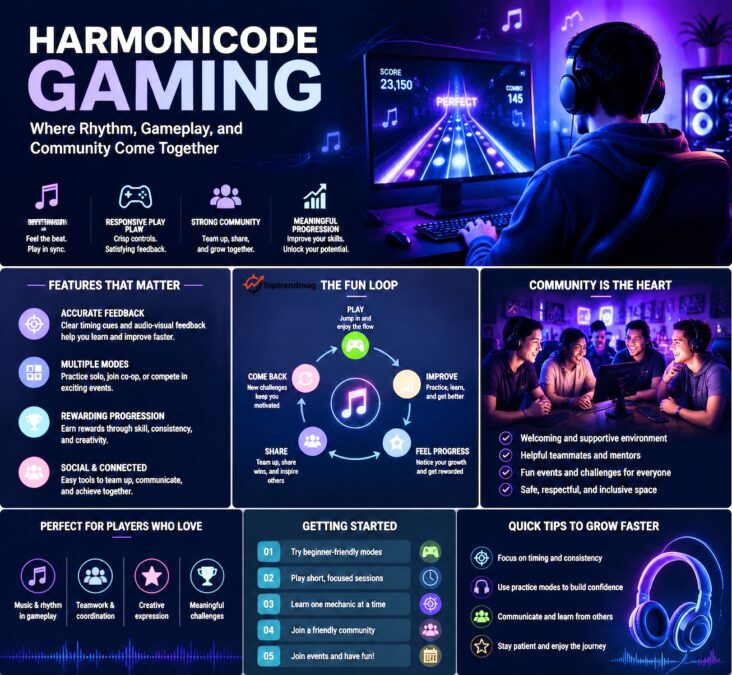
Fun isn’t one thing. It’s the result of multiple small satisfactions stacked together.
The “fun loop” that keeps pulling you back
A strong harmonicode gaming experience follows a loop like this:
- Start: you quickly understand what to do
- Learn: you improve by repeating with slight variation
- Feel it: feedback makes your progress noticeable
- Share it: teammates or community members reinforce your momentum
- Return: new challenges give you a reason to play again
The key is that the loop doesn’t become repetitive. Even if the core mechanics remain the same, new goals and social moments keep the game fresh.
Mastery that feels fair
Players can handle hard games. What they hate is the “unfair hard.” In harmonic-style designs, the game tends to be more forgiving about how you reach competence and more focused on how clearly the mechanics are communicated.
When timing windows and feedback are consistent, players learn the rules faster. That creates the satisfaction of mastery: “I can do this now,” not “I got lucky.”
Creativity inside constraints
A surprising reason players love harmonic-adjacent games is that rhythm/flow systems create constraints, and constraints often encourage creativity. If you’re judged by pattern and timing, you can experiment with different strategies:
- different play styles
- different team coordination patterns
- alternate approaches to the same challenge
That kind of creativity makes the game feel personal. It’s also one of the easiest ways to sustain long-term engagement because you don’t just chase the next level you chase the next improvement.
The emotional side: belonging
A game becomes fun when it’s safe to be a beginner. That means teammates are willing to coach, community discussions are respectful, and people don’t treat mistakes like personal failures.
When harmonicode gaming is supported by a healthy culture, the fun expands beyond the match. Players keep coming back because they want to be part of something, not just because the mechanics are satisfying.
Community: where longevity actually comes from
Lots of games have communities. Fewer communities are healthy enough to stay that way for years.
Culture is built in small moments
Community culture often appears in tiny behaviors:
- welcoming new players instead of gatekeeping
- giving quick help without acting condescending
- celebrating progress, even when someone didn’t win
These habits matter because most players decide whether to return within their first handful of interactions. If that early period is hostile, the game can lose great players permanently.
Events that make participation easy
Community events work best when they feel approachable. A good harmonic-inspired community event has clear rules, short participation windows, and meaningful rewards.
Examples of event formats that support harmonicode gaming audiences include:
- weekly practice challenges
- themed co-op sessions
- community-led “show your setup” days
- seasonal milestones that encourage consistent play
The goal isn’t to turn players into competitors. It’s to create shared experiences that create stories people want to talk about.
Moderation and safety as design goals
Safety isn’t optional. When you build a community around communication voice, chat, or group coordination you also need reliable moderation and reporting tools.
A strong community plan usually includes:
- clear behavior expectations
- a reporting path that works
- moderation that responds consistently
- tools for players to block or avoid harassment
Online communities also face broader risks, including extremist propaganda and harmful coordination patterns on platforms like Discord. That’s one reason research and policy conversations emphasize moderation and safety as structural needs not as afterthoughts.
Even if your community isn’t dealing with serious threats, the principle remains: a healthy space is actively maintained.
Community outcomes: growth and relationships
When community is working, players experience three benefits:
- skill growth through mentorship and feedback
- friendships through repeated collaboration
- identity through shared culture and inside jokes
This is what separates “a place to play” from “a place to belong.”
Getting started without losing motivation
If you’re new to harmonicode gaming, your first objective shouldn’t be beating everyone. Your first objective is becoming comfortable with the game’s “feel.”
Here’s a practical start plan that works for most harmonic-style experiences:
- Begin with the most beginner-friendly mode
Use solo or practice formats if available. Your goal is to understand the timing and feedback. - Play in short sessions
Twenty to forty minutes is enough to notice improvements and avoid frustration. - Focus on one mechanic at a time
If there are multiple systems, pick the one that affects your biggest errors. - Join a small group early
Community makes improvement faster when teammates communicate well. Even joining one friendly squad can help. - Participate in a low-pressure event
Events are often designed to be shorter and structured. They’re also where new players get the most encouragement. - Respect the learning curve
The harmonic vibe usually rewards patience. If you treat it like instant mastery, you’ll burn out.
Who harmonicode gaming is perfect for
Even without a single official definition, you can identify the audience fit by the “feel” harmonicode gaming tends to target.
You’ll probably enjoy it if you like:
- games where timing and pattern recognition matter
- music-adjacent gameplay or interactive audio concepts
- teamwork that feels intentional rather than random
- communities where people share progress and strategies
You might need a different approach if you strongly prefer games that are purely narrative or purely sandbox, with no rhythm/flow emphasis. In harmonic-style experiences, the mechanics are part of the identity.
Community best practices that keep things human
If you’re the kind of player who wants to help grow harmonicode gaming communities or if you’re building your own group around the idea these practices help keep the space welcoming.
Encourage mentorship, not judgment
Instead of “How did you miss that?” try:
- “Here’s what helped me watch the timing window.”
- “Try it slower first, then build speed.”
- “If you want, I’ll run it with you once.”
Those small shifts change the tone instantly.
Create “beginner lanes” for content
When every activity is high-skill, beginners avoid community spaces. Provide:
- beginner-friendly schedules
- practice queues
- simplified event rules
Even if you keep competitive goals for advanced players, you need a parallel path for new members.
Celebrate consistency
A lot of communities only celebrate the highlight moments. In harmonic-style systems, consistency is the real engine of mastery. Celebrate “I improved” stories, not only “I won.”
Keep communication clear
When voice or chat is chaotic, players disengage. Community leaders can help by:
- setting expectations for response times
- using pinned guides
- keeping rule changes documented
This creates trust. Trust is what keeps a community stable.
FAQ about harmonicode gaming
Is harmonicode gaming beginner-friendly?
Most harmonic-style experiences can be beginner-friendly if they offer practice modes, readable feedback, and staged difficulty. If the game you’re trying lacks those elements, beginners may struggle so start with the most guided mode available.
What makes it different from typical online gaming?
The difference is usually the tight link between mechanics and “flow.” Instead of feeling detached from music or feedback, harmonic-style design tends to make the gameplay feel synchronized. That can be expressed through timing windows, audio feedback, or interactive sound influence.
How do communities stay active?
Communities stay active when there’s a consistent loop of participation: events, shared goals, and mentorship. Features that make it easy to team up and communicate also help.
Is there a solo way to enjoy it?
Many players enjoy solo practice even if the community is a big part of the experience. The best setups let you learn mechanics privately, then join events when you’re ready.
Final thoughts
Harmonicode gaming is at its best when it balances three things: gameplay systems that support learning, fun that feels rewarding day after day, and community culture that makes people want to return. When the mechanics are readable and the social space is welcoming, players don’t just chase wins they build confidence, friendships, and long-term motivation.
If you’re exploring this world, remember: start small, focus on the feel, join a supportive group, and let the community help you grow. That’s where harmonic experiences become more than entertainment they become part of your gaming identity.