







Intro
I want to be honest up front: when I first saw the phrase upgrade oxzep7 python, I assumed it was just another trendy upgrade guide something you could follow like a checklist and be done in an afternoon. But the more I dug in, the more I realized I was facing something deeper than a normal version bump.
Because “oxzep7” doesn’t map to anything official in Python tooling, release notes, or common package indexes. Multiple fact-check style write-ups claim there’s no legitimate, verified Python tool or package named Oxzep7 you can safely install or upgrade to. )
So what did I “upgrade,” exactly?
In practice, I upgraded my real Python workflow to a modern, supported interpreter version and rebuilt my environment with safer processes. And along the way, I learned a hard but valuable lesson: when an upgrade phrase looks like a command and sounds like “official,” it’s worth pausing especially if it’s tied to something that can’t be verified.
This post is the story of how I handled that situation carefully, what I changed step by step, and what I learned about upgrading Python environments without breaking your work.
Bio
| Label | Information |
|---|---|
| Topic | Upgrading Python Environment |
| Suspicious Keyword | upgrade oxzep7 python |
| Oxzep7 Status | Not a real Python tool or package |
| My Original Plan | Followed the keyword blindly |
| What I Actually Did | Clean rebuild with modern Python |
| Main Goal | Reliable and reproducible setup |
| Key Tool | Python’s built-in venv |
| Approach | Create fresh environment |
| Dependency Method | Pinned requirements + clean install |
| Testing Step | Full test suite after rebuild |
| Biggest Mistake | Upgrading in place |
| Main Lesson | Verify before trusting any keyword |
| Best Outcome | Consistent installs and less stress |
The promise: what you’ll get from this post
If you’re dealing with an upgrade push right now whether you saw upgrade oxzep7 python in a blog, a comment thread, or a message this article will help you:
- Understand why “oxzep7 Python” is a risky phrase to treat as an actual tool
- Use a reliable upgrade approach that doesn’t depend on guesswork
- Avoid the most common environment mistakes that lead to hours of “why won’t it run”
- Build a checklist you can reuse for your next interpreter upgrade
I’ll keep this practical and human. I’ll also include the kinds of things that don’t fit neatly into “just run this command” posts.
A quick reality check on upgrade oxzep7 python
When I searched the phrase, I found a repeating pattern: people were publishing guides using the python, but the “oxzep7” part didn’t line up with anything verifiable in standard places.
One article explicitly argues that “oxzep7” isn’t a real Python, package, or version and is used in misleading ways.
Another claims it couldn’t verify an “Oxzep7” package in common repositories like PyPI or GitHub.
A separate write-up also states the term isn’t official.
So here’s what I did instead of chasing a questionable “upgrade” command: I upgraded my environment the right way by upgrading Python itself (and then rebuilding the virtual environment and dependencies cleanly).
That approach may not sound as clickable as a viral python, but it’s the method that actually prevents headaches later.
Why I needed to upgrade in the first place
My situation wasn’t “I want the newest thing.” It was “I can’t afford the uncertainty anymore.”
Over time, my project drifted into that familiar state:
- My local setup worked “most of the time,” but CI failures took longer than they should
- Dependency versions felt loosely controlled
- I had a mix of packages installed over time, not a deliberate environment snapshot
- Even small upgrades turned into dependency detective work
The breaking point was when I needed repeatable installs more than I needed “latest versions.” That’s where the upgrade conversation should start: with reliability.
What I changed my plan to (after seeing the oxzep7 python issue)
Once I realized upgrade oxzep7 python wasn’t pointing to a legitimate, official thing, I reframed the goal.
Instead of trying to “upgrade to Oxzep7,” my actual goals were:
- Move to a modern Python interpreter version that’s actively supported
- Rebuild the environment using virtual environments (so changes don’t pollute the system)
- Use the packaging/build process in a way that reduces weird install surprises
- Validate using tests before switching anything important
This is the kind of upgrade that stands up on Monday morning not just the kind that works on your machine once.
Step one: understand your current setup before touching anything
Before I changed anything, I did the boring but critical inventory.
I wrote down:
- Python interpreter version(s)
- Where my project was executed from (local, CI, container)
- How dependencies were installed (requirements files, lockfiles, manual pip install)
- Whether any packages had compiled extensions (these are more likely to break across environments)
This wasn’t because I love documentation it was because I needed a baseline for what “good” looked like.
The “upgrade” goes sideways when you can’t tell what changed and why.
Step two: stop upgrading in place
This part mattered more than I expected.
I didn’t try to mutate the existing environment. I built a fresh one and migrated intentionally.
The underlying idea aligns with how modern Python packaging tries to reduce build/install cross-contamination particularly through concepts like build isolation in PEP 517.
Even if you don’t read every PEP, the practical takeaway is simple:
Upgrades fail more often because environments are messy than because Python is “broken.”
I wanted clean, controlled change.
Step three: create a virtual environment correctly
For the environment, I leaned on Python’s built-in venv behavior. Python’s documentation describes how venv creates an isolated environment and places configuration in the new environment directory.
I treated the virtual environment as a “container for decisions.” If I wanted to test something, I did it there.
That single habit reduced my troubleshooting time dramatically.
Step four: capture dependencies in a reproducible way
I’ve seen a lot of people treat requirements.txt like magic. It’s not.
A requirements.txt can be useful, but it can also be incomplete if it doesn’t reflect the real environment. The most important principle is to ensure installs are reproducible and pinned where needed.
For me, the key was:
- I created or updated my dependency spec based on what my project actually needs
- I verified installs by recreating the environment from scratch
- I checked that tests pass after a clean install, not just after incremental changes
For example, pip freeze is commonly used to export installed packages to a file, and pip documentation describes usage for freezing package state.
But the important part is how you interpret it: a freeze reflects the environment you froze. So the quality of that file depends on the quality of the environment you froze.
Step five: build/install using modern packaging expectations
Another reason installs can become chaotic is packaging differences especially where build steps happen.
PEP 517 defines a build-system-independent interface that packaging tools use, and it addresses build isolation problems that caused inconsistent builds.
You don’t need to become a packaging expert to benefit from this. You just need to stop assuming the install behavior is identical across machines.
So I approached dependency installs with a rule of thumb:
- Build once in a clean environment
- Confirm it works
- Then treat that environment as the source of truth
What actually broke during my upgrade (the real mistakes I made)
Let me share the mistakes I made so you can skip them.
Mistake 1: trusting the phrase instead of verifying the software
When I saw upgrade oxzep7 python, I almost went down the path of “install this thing.” But when multiple sources said “Oxzep7 isn’t a verified legitimate Python tool/package,” that was my stop sign.
Even if a tutorial sounds convincing, the upgrade process should be grounded in verifiable tooling: Python releases, supported packages, and standard repositories.
Mistake 2: upgrading dependencies without recreating the environment
At first, I tried to do incremental updates inside an environment that had already been used and modified over time.
That made failures harder to interpret because multiple variables changed at once.
Mistake 3: not running the full test suite early
I would get “it imports now” and assume I was done. Then later, runtime behavior or integration tests would reveal the missing compatibility edge.
The fix was straightforward:
- Run tests after clean install
- Don’t celebrate early import success
The biggest wins (what improved once I rebuilt properly)
Once I stopped treating “upgrade oxzep7 python” as a tool and instead rebuilt cleanly, my project started behaving like it should.
Here’s what got better:
- More consistent installs: when I recreated environments from scratch, behavior matched far more often
- Faster debugging: fewer “mystery” issues caused by leftover packages or cached build artifacts
- Cleaner dependency story: it was clearer what my project truly depended on
- Less CI churn: I reduced the cycle of “CI failed, local works” surprises
And the emotional part? I felt calmer. That may sound silly, but it matters. Upgrades are stressful when you don’t know what you changed.
What I learned (and how I think about upgrades now)
Lesson 1: A viral python isn’t a release
If a phrase like upgrade oxzep7 python can’t be tied to a verified tool or package, treat it as marketing noise or misinformation until proven otherwise.
Lesson 2: Recreate, don’t mutate
Upgrades are safer when you build a fresh environment and migrate deliberately.
Lesson 3: Use Python’s environment tooling to isolate risk
The official venv approach exists for a reason: it keeps interpreter and dependencies from colliding with system state.
Lesson 4: Packaging expectations matter
PEP 517 and build isolation concepts exist because inconsistent builds are painful.
Lesson 5: Make tests part of the upgrade rhythm
Import success is not the same as working software.
Lesson 6: Reproducibility beats “latest”
Even when upgrading to a newer interpreter, your priority should be predictable behavior especially if the project touches production or business-critical workflows.
Common pitfalls I’d warn you about
These are the issues I’d expect you to hit if you’re trying to upgrade under pressure.
Pitfall 1: Installing something based on an unverified name
If “Oxzep7” shows up as an install target, pause. Look for verification in standard places and compare claims against credible references.
Pitfall 2: Upgrading in place
If you reuse an environment that already has drift, your troubleshooting becomes a guessing game.
Pitfall 3: Assuming requirements files are automatically correct
Your dependency spec should reflect what you actually run, not just what you’ve installed at some point.
Pitfall 4: Skipping the clean-install test
Always recreate the environment from scratch at least once. That single check catches hidden assumptions.
A simple checklist you can reuse
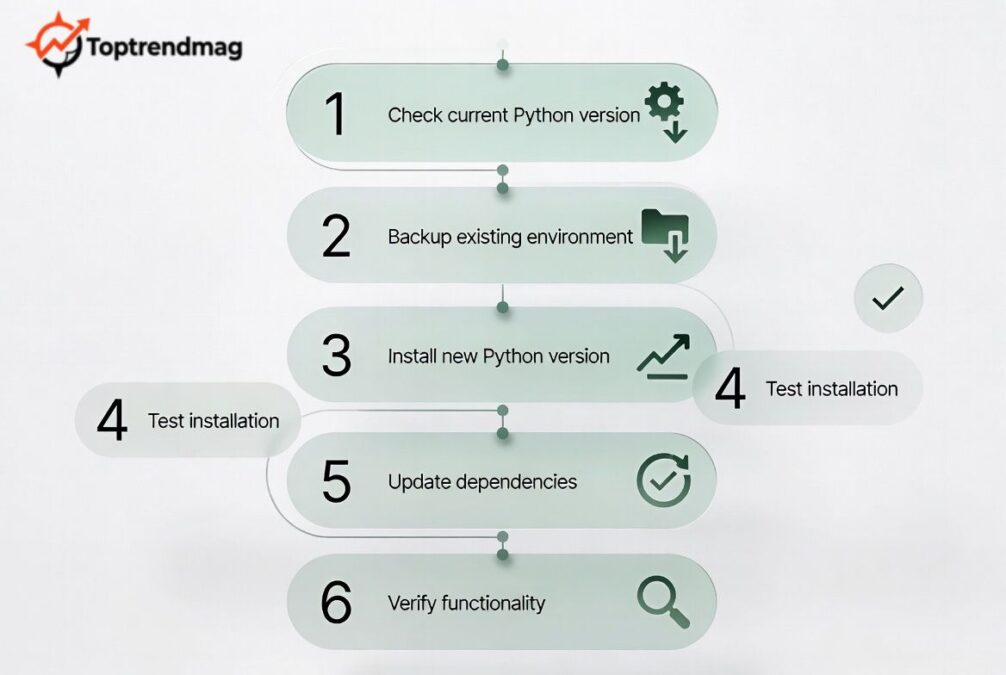
If you’re about to perform an interpreter upgrade, here’s my approach.
- Write down your current Python version and how you run the project
- Create a new virtual environment
- Install dependencies from a controlled spec
- Run the full test suite (or your project’s closest equivalent)
- Only then consider switching workflows
- Keep the old environment around until you’re confident
This is the “calm upgrade” method.
FAQs
Is “upgrade oxzep7 python” an official Python upgrade?
No clear verification exists that “Oxzep7” is an official Python tool or package. Treat it as a claim you should verify before acting.
What should I do instead of upgrading to “Oxzep7”?
Upgrade your Python environment in a reliable way. Create a new virtual environment, rebuild dependencies cleanly, and validate with tests before switching.
Why is a clean install safer than upgrading in place?
In-place upgrades can carry hidden leftover packages, caches, or build artifacts. A clean install gives you a clearer cause-and-effect when something breaks.
How can I make my dependency setup more reproducible?
Use a controlled dependency spec and reinstall from scratch at least once. Then confirm behavior matches after a fresh environment build.
What’s the first thing I should test after upgrading?
Start with the full test suite, not only “it imports.” Run the checks that cover integration and runtime behavior so you catch real issues early.
Conclusion: the upgrade I actually made
I went into this thinking I would follow upgrade oxzep7 python instructions like a normal upgrade guide. I didn’t.
Instead, I made the real upgrade that mattered: I upgraded my Python workflow in a way that’s verifiable, reproducible, and safer by rebuilding the environment cleanly and validating with tests.
And the biggest takeaway is simple:
When upgrading Python, the safest path isn’t the newest-sounding label. It’s the one you can reproduce and verify.
If you’re currently working on an upgrade, tell me what you’re trying to move to and what broke first. I’m happy to help you think through a clean, low-drama path.